Metric mapping drift and why it breaks reporting
Metric mapping drift happens when a KPI keeps the same name but quietly changes meaning as it moves between ad platforms, analytics, spreadsheets, BI, and CRM systems. The dashboard still says “CAC,” “Revenue,” or “Leads.” The definition underneath is different. Teams optimize to the wrong target, and nobody notices until performance and finance numbers stop matching.
This is common in modern stacks because each system has its own schema, attribution rules, time zones, currencies, and event models. Even small “harmless” edits—like reclassifying a campaign, changing a UTM rule, or introducing a new conversion event—can shift the KPI while the label stays the same.
Common patterns of “same KPI, different definition”
1) Platform conversions vs analytics conversions
Ad platforms report conversions based on their own tracking and attribution windows. Analytics tools often report conversions based on session-based rules and last-click defaults. A KPI called “Purchases” can represent different user actions, different deduping logic, and different attribution windows. If you blend them without an explicit rule, the number becomes a mash-up, not a metric.
2) Leads in CRM vs leads in ad platforms
Many teams call any form submit a “lead,” but the CRM may only count a lead after enrichment, deduplication, or a status change. If “Leads” means “form submits” in one place and “new CRM records” in another, cost per lead will swing based on pipeline operations, not marketing performance.
3) Revenue can mean booked, recognized, or attributed
Revenue is the classic drift magnet. In a CRM it might be “Closed Won amount.” In finance it may be recognized revenue. In analytics it might be ecommerce revenue excluding refunds. In attribution tools it might be modeled revenue credit. If a dashboard labels all of these “Revenue,” you end up with debates instead of decisions.
4) Currency and tax handling changes the KPI without warning
Ad spend might be in account currency. Revenue might be in billing currency. Some sources include VAT/GST; others don’t. Teams often “fix” this downstream in a spreadsheet. Then a new region launches, and the fix no longer holds. The KPI name stays stable while its calculation shifts.
5) Time zone and date logic differences
“Daily spend” in one system can be based on Pacific Time while another uses UTC. Add late-night conversions and a KPI like “ROAS yesterday” becomes impossible to reconcile. Drift often appears as small daily discrepancies that become large monthly gaps.
How to detect metric mapping drift early
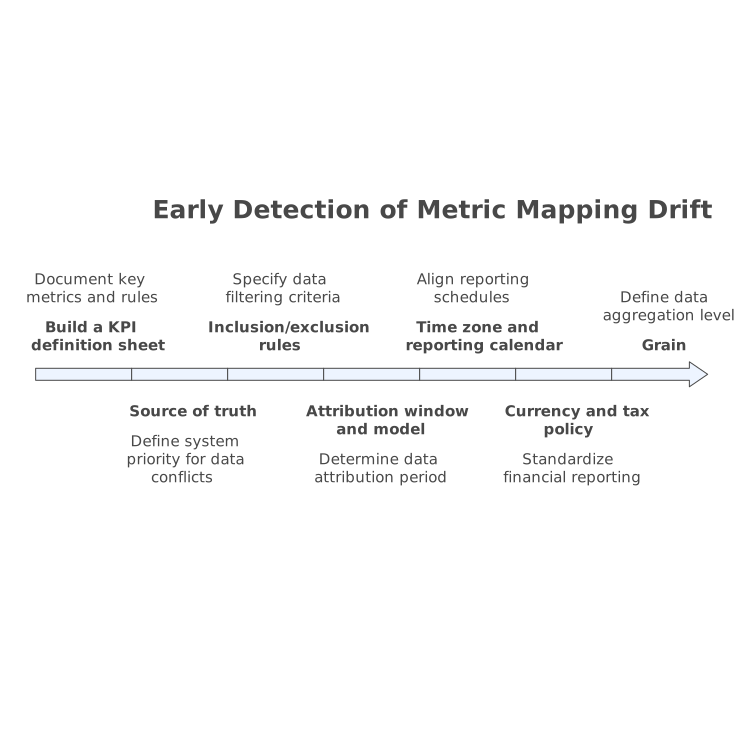
Build a KPI definition sheet that is machine-checkable
A definition doc is only useful if people can apply it consistently. Keep it simple and enforceable. For each KPI, document:
- Source of truth (which system wins when numbers disagree)
- Inclusion/exclusion rules (refunds, test traffic, internal users)
- Attribution window and model (if applicable)
- Time zone and reporting calendar
- Currency and tax policy
- Grain (event, session, user, account, opportunity)
If you want a lightweight way to align stakeholders quickly, a short diagram of how metrics flow can remove ambiguity fast. The 30-minute system diagram workflow is a practical format for getting everyone to agree on where definitions change.
Run reconciliation tests on a schedule
Don’t wait for a quarterly post-mortem. Set a recurring cadence—weekly for core KPIs, daily for high-spend accounts—to compare:
- Spend by platform vs your unified dataset
- Key conversions by platform vs analytics events
- CRM pipeline adds vs tracked lead events
- Revenue totals vs finance/CRM baselines
Use tolerances rather than expecting perfect matches. The goal is to detect changes in deltas. A sudden shift from 2% variance to 12% variance is usually drift, not “noise.”
Monitor schema and mapping changes, not just numbers
Numbers drift because something upstream changed. Track changes like:
- New conversion actions created in ad accounts
- Event name changes in analytics
- New campaign naming conventions
- CRM field edits or pipeline stage changes
- New tracking templates and UTM rules
If your process only checks totals, you’ll catch issues late. If you track upstream changes, you’ll catch issues when they happen.
How to fix drift without breaking trust in reporting
1) Choose a single source of truth per KPI
Not one source of truth for everything. One per KPI. For example:
- Spend: ad platform billing spend
- Site conversions: analytics events
- Pipeline: CRM object creation and stage changes
- Revenue: finance-recognized or CRM booked, but pick one
Then document where each KPI is allowed to be “directional.” Platform conversions can still be useful, but you must label them clearly and keep them out of blended KPI math unless you’ve formalized the rule.
2) Standardize naming and build KPI calculations once
Drift accelerates when each dashboard rebuilds KPIs differently. Standardize dimensions (channel, campaign, source/medium) and calculate KPIs once in a shared dataset. This is where marketing data infrastructure helps: teams connect sources once, normalize fields, and then reuse the same definitions across BI and spreadsheets.
Funnel.io is designed for this layer: collecting data from advertising, analytics, and CRM tools, applying transformations like naming harmonization and currency conversion, and delivering an analysis-ready dataset that teams can rely on across reporting destinations.
3) Introduce versioning for KPI definitions
KPI definitions change. Pretending they don’t creates confusion. Add lightweight versioning:
- v1: Original definition
- v2: Updated conversion logic after GA4 event change
- Effective date: when the new definition starts
- Backfill policy: whether you restate historical data
This prevents the “why did February look different last month?” spiral. If you do backfill, communicate it as a data restatement with scope and dates.
4) Put metric ownership in writing
Assign an owner for each KPI definition. The owner is not the only person allowed to suggest changes, but they are responsible for approving and communicating them. Without ownership, drift becomes everybody’s problem and nobody’s job.
If you need a simple way to prioritize fixes, weigh issues by business impact. A reconciliation gap on revenue attribution matters more than a small mismatch on clicks. A revenue-weighted scorecard approach translates data quality work into clear prioritization.
Operational guardrails that keep KPIs stable
Use explicit labels for similar-but-not-equal metrics
Instead of calling everything “Conversions,” label metrics to reflect definitions:
- Conversions (Platform, 7-day click)
- Purchases (Analytics event)
- New leads (CRM records)
Clear labels reduce accidental blending. They also make it easier to explain discrepancies without turning it into a blame game.
Separate reporting KPIs from optimization KPIs
Ad platform metrics can be excellent for in-platform optimization. They are not always the right choice for cross-channel reporting. Separate the two sets intentionally. That way, drift in an optimization metric does not silently corrupt executive reporting.
Make drift visible with alerts and thresholds
Set automated alerts on key reconciliation deltas and on schema changes. The best time to fix drift is the day it starts, while the change is fresh and reversible.
What “good” looks like after the fix
When metric mapping drift is under control, teams stop arguing about numbers and start arguing about actions. KPI definitions are clear, documented, and reused. Differences between systems are expected, labeled, and bounded. Reporting becomes stable enough to support budget changes, forecasting, and experimentation without constant rework.
Vertical Video